
The PoliPro Method
During World War II, the military examined planes that returned from missions and mapped where they had been hit by enemy fire—wings, fuselage, tail, etc. The initial instinct was to reinforce the areas with the most bullet holes. However, statistician Abraham Wald pointed out the critical flaw: the data only included planes that survived.
The correct inference was that armor should be added to the areas with few or no bullet holes, because planes hit in those locations did not make it back. The absence of damage was the signal—not the presence of it.
Today, the echo chambers created by social media exemplify the same trend of survivorship bias, the logical fallacy in which we ignore unseen failures and focus only on our visible successes. Just like how the military in World War II ignored the true points of weakness on returning planes, social media creates the same systemic flaw in our ideologies. Algorithms flood users with content that confirms existing beliefs, because affirmation drives engagement. Contradictions and counterarguments are filtered out, not because they lack merit, but because they interrupt the engagement cycle. The result is an ideology reinforced at its strongest points while its weakest points remain unexamined.
The result is the same as it would have been in World War II. Like armor placed over existing bullet holes, this reinforcement creates the illusion of strength while leaving critical gaps exposed. Beliefs appear well supported but remain structurally fragile.
PoliPro reverses this pattern. Instead of reinforcing what is already visible, it identifies the unseen vulnerabilities in your thinking. It directs attention to opposing arguments, exposes weak points, and then helps strengthen them—building durable intellectual armor rather than hollow reinforcement.
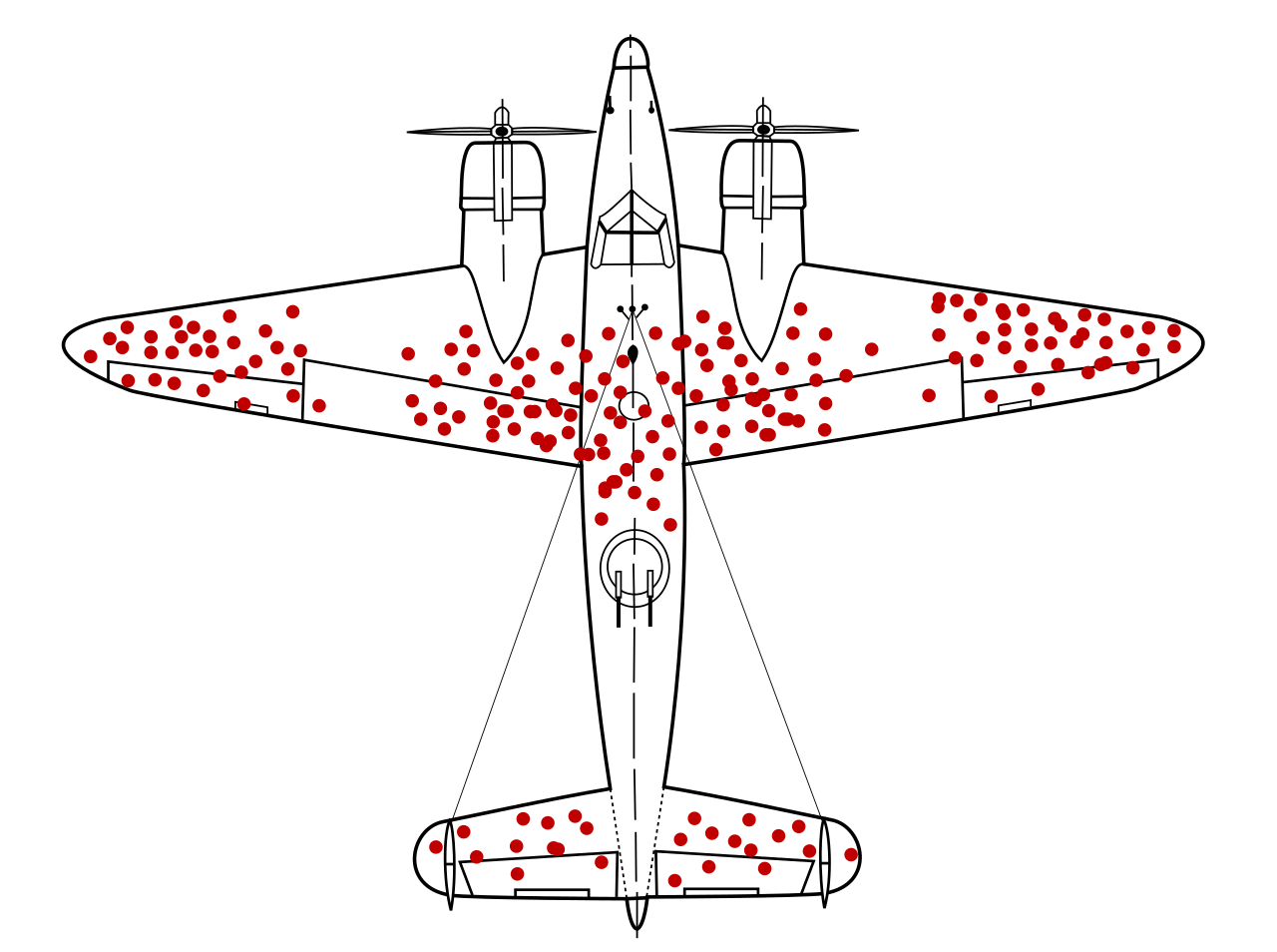
The military reinforced the areas in red, where the returning planes had taken the most damage, ignoring the areas that were untouched. While intuitive, this strategy was disastrously flawed and left planes vulnerable.